Story and photos by Lauren Hines-Acosta
Sonya Silver and her family had been paddling on the Rivanna and James River for the last seven days. Rainstorms had soaked them, and their weathered hands pushed their canoes through 100 miles of low water. But they had never been freer of life’s demands.
“[We were] living on the edge, and kind of living the life of a pirate,” Silver said.
Their voyage began in Charlottesville, VA, on the Rivanna River. Their destination: Sharp’s Island, in the shadow of downtown Richmond.
It’s one of the only privately owned islands on the James River where people can camp. Many have tried to make a more lasting mark on the patch of land, only for the river to remind them who really owns it. Visitors can experience the natural rhythms of the river while the opportunity remains.
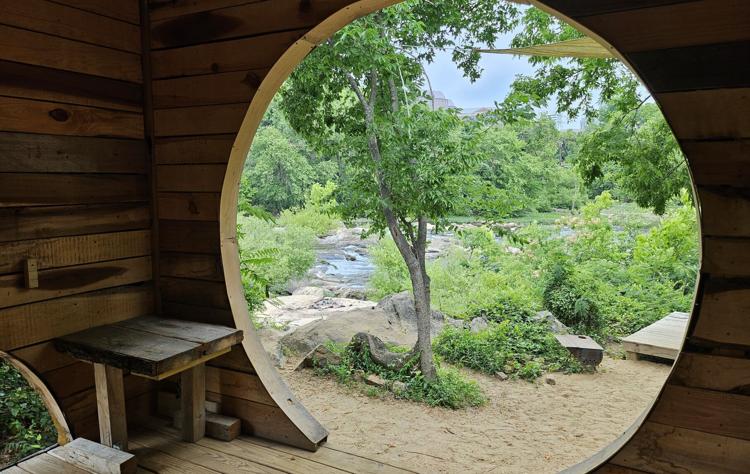
Rapids bisect the island, which has rocky outcrops on its western tip and sandy beaches on the eastern end. It lies squarely across the last line of rapids at the downstream edge of the fall line, where Piedmont granite meets the lower and softer Coastal Plain. It’s only a few hundred feet from the busy 14th Steet bridge and a few thousand feet from downtown Richmond, but the rushing river generally masks the sounds of city life. The island offers an intimate, hidden view of the ecosystem just under Richmonders’ noses.

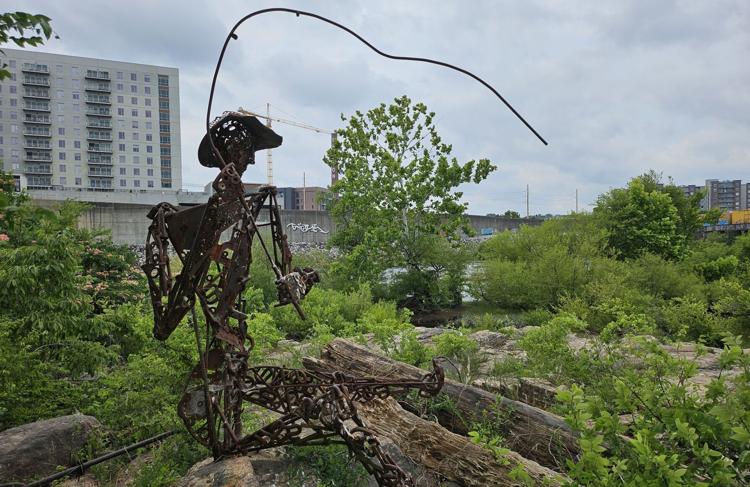
Andy Thompson, co-owner of the island, lists Sharp’s Island on Airbnb and Hipcamp. He outfitted it with an artistic shelter, a grill and an outhouse. And there’s a wooden platform that could be used for camping, sunbathing or concerts. Plus, direct access to the river invites visitors to fish or paddle. For those with no interest in running rapids, the island also has a sort of natural bathtub — a pool lined with smooth rock — for relaxing dips.
Thompson isn’t the first to build on the island. This acre of land earlier changed hands between members of the Sharp family, starting with a Richmonder named George Sharp in 1873. Newspaper archives show that he built a two-story brick house on the island. He also held parties there for associations and clubs that he led.
A few generations later, descendent Russel Sharp inherited the island, sometime before 1931. Then, in 1935, his friend Fred Hastings began living there as caretaker of the house and island. That brick house likely holds the record for staying intact the longest, despite flooding.
In 1968, architect Henry Tenser was commuting from Powhatan County to Richmond one day when he saw the two-story house from Mayo Bridge. He bought the island from Sharp for $2,000. He had a vision for building an avant-garde cube structure there, very different from his usual projects like the American Tobacco Company restaurant in the city.
Flooding had damaged the brick house beyond repair, so the city let Tenser burn it down. But in 1972, soon after he had finished building frames for a structure made of cubes, Hurricane Agnes delivered a devastating flood. Remnants of the cubes can be found along the south bank of the island.
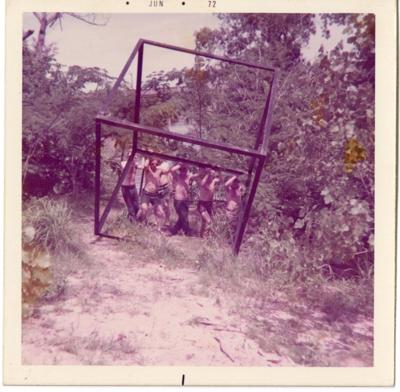
Tenser moved on, and the island changed hands many times until 2018, when Andy Thompson and nine other families purchased it. Some people tell Thompson it was a crazy decision, but he felt he had to jump on the opportunity.
“It’s like you see the vision of what it could be, and I just get like obsessed with that,” Thomspon said.
Thompson built two previous shelters, and floods washed them away. But he’s not trying to tame the island. He knows he’s at the mercy of the river.
“What I’m hoping is that the James will give me maybe five, maybe 10 years,” Thompson said. “That’d be nice, but obviously there are no guarantees.”
The land truly is wild. He can’t take a week off or else nature will overtake the island. He said this as he pulled weeds from the deck like a clown pulling endless handkerchiefs from a sleeve.
“You’re always fighting Mother Nature for control of this island,” Thomspon said.
During the eight years he has managed Sharp’s Island, he has noticed the river’s rhythms. He sees geese nest on the island from April to May. He sometimes spots Atlantic sturgeon, once thought to be extirpated from the Chesapeake Bay watershed, in spring and fall. Ospreys arrive in the spring to build nests and raise their young. In the winter, the isolated island is perfect for a small campfire and smores.
One Richmond Times-Dispatch article applauded Russel Sharp for catching a 250-pound sturgeon by the island in 1922. But life in the river has changed since the Sharp family owned the island.
Overfishing from commercial harvesting decimated some fish species, like Atlantic sturgeon and American shad, by the late 1800s. Pollution and dam construction altered their spawning grounds in the river. The National Oceanic and Atmospheric Administration listed sturgeon as endangered under the Endangered Species Act in 2012, and American shad have not returned to the James. Nonprofit groups throughout the watershed are actively working to build back these populations.
Silver said she and her family were “so emotional” after reaching Sharp’s Island. Filled with a sense of accomplishment, they were rewarded with blue herons transiting a sunset and the river soothing them to sleep.
“[Sharp’s Island is] just so uniquely situated,” she said, “and the amount of wildlife activity that is happening there — I mean it’s just kind of this magical, powerful joining of the sea and the mountains all coming together right there.”
If You Go
Sharp’s Island in Richmond can be booked on Airbnb and Hipcamp. Weekends fill up fast, but weekdays are often open for concerts, corporate parties and co-working. The cost is $75 to $135 per night. Visitors can park overnight for free along streets in the Manchester neighborhood. The island can only be accessed by canoe or kayak, so bring your own or rent one from the island’s manager (one for $65 or two for $100). The island also features a Free Little Library, so feel free to bring a pirate book to leave for your fellow adventurers. Visitors can check the James River Association’s James River Watch map for the latest water quality data.
Other islands to visit in the Bay watershed
- Tangier Island, VA, is one of the few inhabited islands in the Bay. Visitors will encounter a unique culture or working watermen and their families. Along with fishing and kayaking, you can enjoy historical tours or go crabbing with an experienced fisherman. Be sure to stop by the Tangier Island Museum.
- Janes Island State Park, MD, lies just offshore of Crisfield. It features almost 3,000 acres of saltmarsh and 30 miles of water trails. Visitors can fish, crab, paddle or boat along the shore. Day-use is free, but use of the boat ramp costs $7 for Maryland residents and $9 for out-of-state residents. Campsites and rental lodges are available on the mainland portion of the park.
- Hart-Miller Island, MD, is a state park offshore of Baltimore. The 1,100-acre island offers a long beach for wading or sunbathing. The two connected islands, Hart and Miller, have calm waters for fishing and boating. More than 20 campsites are available for $6 per night from May 1 to Sept. 30.